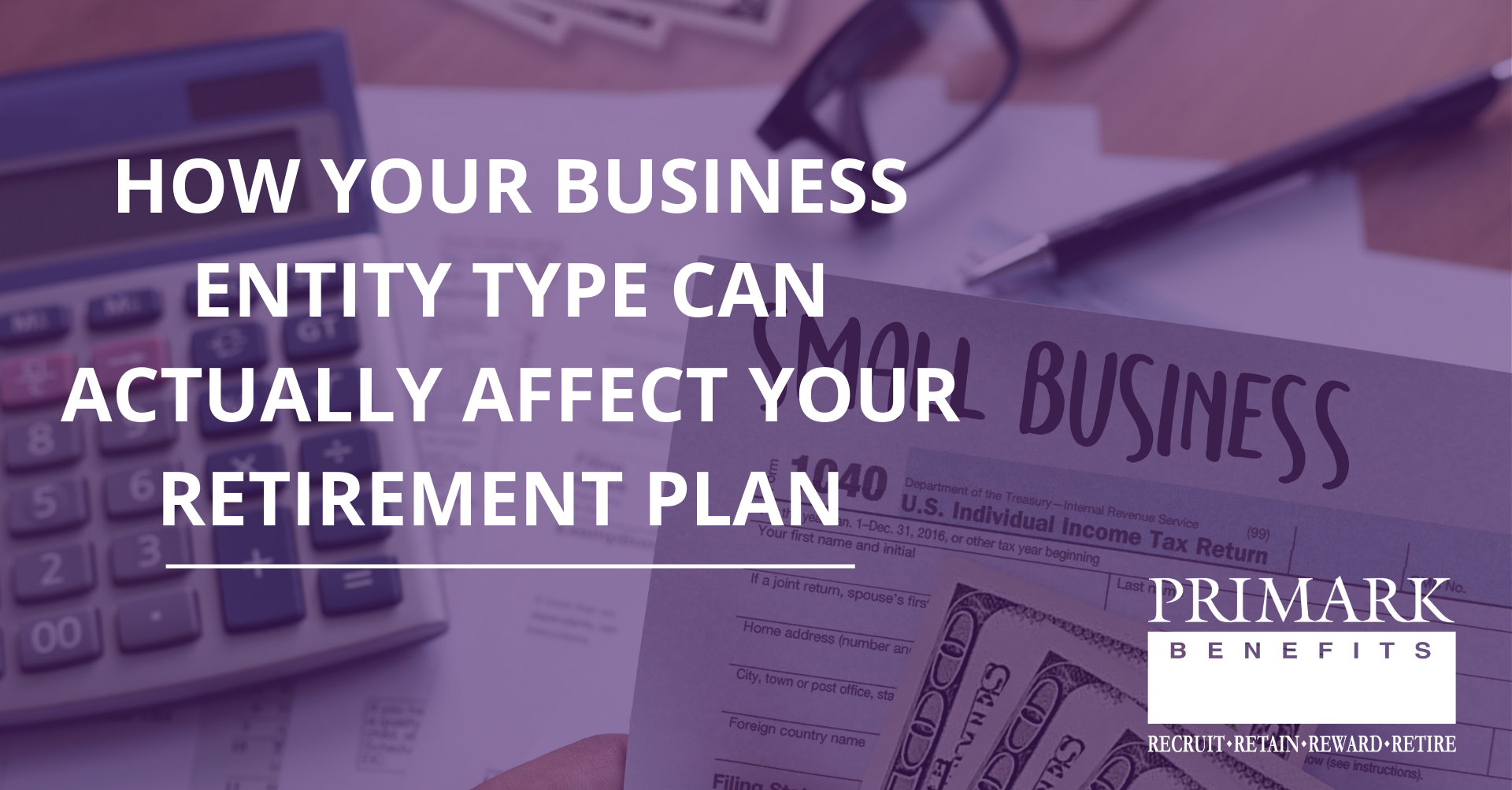
How Your Business Entity Type Can Actually Affect Your Retirement Plan
Most business owners focus most of their attention on revenue and growth, thinking about taxes only when necessary. Yet the structure of a business plays a pivotal role in retirement planning, influencing contribution limits, deductions, and long-term outcomes. Understanding the relationship between entity type and retirement planning is critical to maximizing contributions, deductions, and long-term retirement income.
LLC, LLP, S Corp: What Does It All Really Mean?
When we ask business owners to provide their business entity type – i.e., whether they are a partnership, sole proprietorship, or S corporation – many respond, “I’m an LLC” or “I’m an LLP.” While these latter designations do, in fact, describe one’s legal entity under state law, they don’t determine federal tax classification. In fact, an LLP or LLC can be federally taxed in several ways: as a partnership, a sole proprietorship, an S corporation, or even a traditional C corporation.
For retirement planning purposes, a key question is: How is your business taxed federally? Tax treatment determines how compensation is defined for retirement plans, which directly affects contribution limits and deductions. While nearly every business owner—whether a sole proprietor, partner, or corporate officer—can ultimately contribute a similar percentage of their income, the way those contributions get calculated can differ. Those differences largely stem from how Social Security and self-employment taxes get factored.
The S Corporation “Trap”
Possibly the most common misconception that we encounter is this: Many business owners are advised by their CPAs or accountants to form an S corporation, conceivably to reduce their FICA and self-employment taxes. While it’s true that S corp owners can divide their income classification, namely into salary and distributions, only S-Corp W-2 wages count for retirement plan purposes, not distributions. This can create unintended consequences for retirement planning.
For example, suppose a business owner previously earned $300,000 / year as a sole proprietor. As a potential tax-saving strategy, they form an S corp and begin paying themselves a smaller salary, say $50,000. This allows them to treat the remaining $250,000 as S corporation distributions rather than wages, thereby avoiding both Social Security and Medicare taxes on that portion.
However, this strategy may backfire in both the short- and longer-term. In the short-term, since pension plan contribution limits are calculated based on compensation levels, the lower salary under an S Corp arrangement limits how much you (and your spouse) can contribute to a plan and deduct on your taxes.
Longer, term, you’ll be setting yourself up for lower Social Security benefits at retirement. : A $50,000 salary generates far lower benefits than $300,000 would have.
Why Salary Matters for Retirement Plans
Many high-earning business owners want to maximize contributions for themselves, while also minimizing any costs they incur for employees. Here’s the catch: To be in compliance with ERISA laws, retirement plans must pass annual nondiscrimination tests, which ensure a plan isn’t biased unfairly toward highly-compensated employees. Many people don’t realize that both compensation and age are taken into account when making these calculations.
So, if a business owner’s salary is lower than average staff salaries, it’s difficult to allocate large plan contributions to himself; he’d have to also give disproportionately high contributions to his employees in order to remain in compliance with ERISA. This is because nondiscrimination testing compares contributions as a percentage of plan compensation, not just raw dollar amounts. As a result, a low owner salary essentially caps how much that owner can contribute, unless he is willing to increase contributions for the broader employee group.
Instead, raising the owner’s salary can actually reduce overall employee costs in the plan while allowing the owner to contribute significantly more for retirement, which more than makes up for any additional FICA taxes the owner will owe.
Key Takeaways
Legal entity vs. tax classification: Your LLC or LLP designation as a legal entity is separate from your corp designation for tax treatment. For retirement purposes, what matters is whether you’re taxed as a sole proprietorship, partnership, or corporation.
S corp strategies can backfire: While trying to avoid taxes, low owner salaries both limit current retirement contribution amounts AND reduce future Social Security benefits. Salary drives retirement potential: To optimize defined benefit, cash balance, or profit-sharing plans, owners often need to maintain higher compensation relative to employees.
Nondiscrimination rules matter: Both employee age and compensation affect how contributions can be allocated, impacting retirement benefits for employees and owners.
Net-net: Ultimately, the goal is to balance tax planning with retirement optimization. Sometimes, taking a slightly higher salary today can mean significantly larger retirement benefits tomorrow.